



October 27, 2019
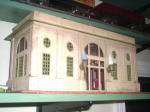
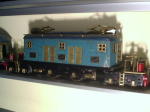
After reading Josh Wayne’s build story (Building A Tinplate Dream) it sounds like me. I started out quite late in life playing with toy trains and collecting them. For several years I got to the Denver CO train shows where I often bought under the table parts. As a kid we had mainly Lionel 0-27 sets. Partly do to costs I got into prewar 0-27 tin plate. I find mid 1930s engine shells that can be re-powered with Marx motors and fixed with JB Weld epoxy. They usually run good for kids to play with at Christmas time. Some shells come from Japanese friction toys, too. I like Lionel, Ives/Bing and Hornby. Hornby electrics are fairly pricy so I have built some engines to pull Hornby cars. I had a computer crash and lost most of my photo files. Will need to rebuild it to show examples of my modeling. This early Lionel 253 is a resent restoration. Below is a snow plow made from a Lionel tin plate caboose. The chassis frame may be from a JeP car. The roof is a tin can. The diner was a pressed steel pull toy which is a better scale for 0-27 than the Lionel ones.
Hugh Nutting in MT
December 9, 2016
To Barbara Jones: I have a Christmas train display that I put up every year in early Nov. It resides on a table that I built with a 1/4 inch plywood top. The very frustrating aspect of this set up is the noise that is produced when the two trains and the cable car are running. Mistake No. 1 was my screwing the track down to the plywood. I have searched the internet for approximately two years to come up with a simple solution before I came across Tinplate Times and your article entitled Soundproofing That Works. After reading your article, I purchased foam strips used to insulate doors (3/8"W x 1/2"D) and placed the cut strips under each track tie and removed each screw. I couldn't believe the results. The noise reduction was approximately 75 to 85% . Thank you for coming up with such a simple fix and it's perfect for a seasonal train display. One of my trains is an American Flyer freight train that my parents purchased sometime between 1940 and 1943. It still runs extremely well and is in excellent condition. The other train is a Lionel passenger train I purchased about 10 years ago along with a Christmas theme cable car. My set up occupies approximately 60 square feet of space and is adorned with Mervyn's Classic Village buildings and figures. Now I can enjoy all of this much more knowing your silencing methodology is working extremely well.
Thank you very much.
Ray Disperati
Scotts Valley, CA
October 19, 2015
Hi ,
I admire Roy James’ layout greatly as he has done an amazing job. I would
like to know what grit of GARFLEX abrasive block he uses. I have constructed
a cleaner using the block with 240 grit and am wondering if a courser grit would
be advisable. I am cleaning a lot of Gargraves track.
Thanks
Richard Orgel
TCA 75-7474
Reply from Roy James:
As regards what Garyflex block grit I use depends on the
circumstances.
The object is to polish the track not wear it out as the blocks cut down are
towed by certain trains.
This enables me not to have to clean the track by hand. The track I use is nickel
silver and is very hard.
I am unaware of Gargraves track but would point out that some track of aluminium
composition be very wary of using these blocks.
For normal use I use the fine grade weighted with 1/16 piece
of lead on the back when the track is clean it will keep it clean.
For outside running and the start of the season I use the coarse grade again
weighted as above.
I hope this helps.
Regards Roy.
November 22, 2013
Dear Bryant
In your delightful article and links you mention certain key French makers.
In 1928 Marescot produced an EtAT pacific and coaches which really defined the way scale appearance three rail would go leading right through to MTH. They were built to a scale 23metres to one metre. One unique feature at that time was the opening smoke box door with internal bulb.
They were later absorbed by Fournereau. I even had a Japanese version based on the ETAT model which featured in my interesting locomotive series on the ATOC (ACE Trains Owners Club)Forum some time ago.
Glad I could be of assistance in some small way in your compilation.
Allen Levy
February 19, 2013
Dear Editor,
I have recently acquired an O gauge 3 unit “Flying Hamburger” set which I believe to have been produced by Hans-Gerhard Mundhenke. Are you able to advise the approximate date of manufacture and how many such units are likely to have been produced ?
Is the manufacturer able to be contacted directly by email ?
Look forward to your reply.
Regards
Alan Harris
Reply from Bryant Booth:
Greetings Mr. Harris,
Jim Kelly-Evans, the editor of the Tinplate Times, asked me to respond to your email regarding the HGM Flying Hamburger and I am pleased to do so.
HGM made at least three “Triebwagens”, two were models of electric powered units and one was a diesel powered, three unit train in a dark blue and cream livery – the DRG SVT Bauart “Leipzig”. I think this model is your “Flying Hamburger” since the actual Flying Hamburger was a 2 unit train I think.
Typically HGM produced between 10-40 sets/pieces of a given model. I do not know what year the HGM model was produced however I am pretty sure that Herr Mundhenke would respond to your correspondence. He can be reached at tommys-toyfair@web.de .
I hope this answers your questions. Thanks for looking at my article in the Tinplate Times.
Regards – Bryant Booth
January 20, 2013
Subject: TINPLATE TIMES web info
Hello,
I like very much your web info concerning collectible European tinplate toy trains. It surprises me to see so many good quality manufacturers for this small but growing market. Probably I will purchase the new nice electrical locomotive made by Merkur. Please, keep me updated.
BR,
J.Likos
October 11, 2012
Subject: Paya article
Wonderful and informative piece. A very small nit to pick though.
Interpreting the sentence in Part II "But PAYÁ continue to produce the same 0 gauge items into the mid-60s, the last European company to produce ready-to- run, ‘0’ gauge trains", to mean 64 -66, it should be noted that Merkur of Czechoslovakia produced ‘0’ gauge trains through 1968 and, in fact, introduced at least 1 new piece in 1968. Some of the pieces had been produced since 1935. Their range of train product was smaller than Paya.
As I said, very small nit offered in the interest of historical accuracy.
Bob Browning
Bryant Booth responds:
Greetings Robert,
Jim Kelly forwarded your comment to me regarding the “last European company to produce ready-to-run 0 gauge trains.” Your point is correct if Merkur was still producing their trains in 1968. I do not know the actual year in the 60’s that PAYA stopped making ‘0’ gauge trains other than the term “mid-60s”. And I did not consider Merkur’s history adequately. A more appropriate statement should probably be “... one of the last European companies ... “.
Thanks for reading the article and taking the time to provide your comments. Feedback is very important.
Regards – Bryant
Bob Browning responds:
Bryant,
Merkur did produce through 1968 and, in 68, oddly changed the design of the tender for their large lok which had been the same since 1937 (possibly 36). Obviously a rare piece. Then train production bit the dust. Merkur continued making construction sets (like Erector) that they had started doing in 1920. They did not produce from 1940 (or 41) until 1947.
As I said, great piece and one I will keep in my archives for reference.
Bob Browning
October 11, 2012
I have always enjoyed your articles especially the Paya article as I have a soft spot for Paya 0 gauge trains. This article filled in lots of gaps in my knowledge of Paya, they often got the "Lada of the toy trains" label in the past but they are colourful real toys and with a bit of work can be made to run well.
Bryan Pentland
October 4, 2012
Hello; Just wanted to say how much I enjoyed the article about Paya trains by Bryant Booth. I have a small collection of the 4 wheel cars some with bad wheels: would you know of anyone making replacements. Thanks once again for your article.
Wayne Harrison (TCA,LCCA)
October 2, 2012
Welcome back!
Best of luck and happy training.. Have some fun!!
Frank Samaritano, PA
October 1, 2012
RE: Howard Set
Nice job on a very interesting set.
Jim Nicholson
June 24, 2011
Subject: THE ANTIQUE COLLECTOR AND HISTORIAN - LIONEL BRASS LOCOMOTIVES
Hi.
I read this article again and find that it is true except for
the following sentence: "For a long time collectors wondered at Lionel
continuing to use the cut out of the old body style 1912 Special body, renumbered
“53” in their catalogs ..."
The renumbered "53" should read as a renumbered 54. Similarly, the
sentence could also read as ... the old body style 1911 Special body, renumbered
"53" ... (but the subject is brass locomotives). Our friend LH got
it mixed-up. On the other hand, the fact that LH found out about the surplus
of square brass 1912 Special bodies is very good information on this subject.
TPT should point this out for your readers. BTW, it's a great article for readers
that understand this stuff.
Thanks,
Paul Kovacs.
January 8, 2011
Jim,
Great edition all around but my fave is the McKeen. I'd love to know more about
Sergio and his work techniques. To use only simple hand tools constructing the
McKeen cars represents tremendous skill. Truly an artist. Perhaps he would be
inclined to write a step-by-step constructing a simple accessory out of sheet
metal.
Brian Olson
Cedar Rapids, IA
January 8, 2011
RE: The Little Engine That Could
Nice article. My interest is in how the 2 tenders were made
into one? Any information on how this was done?
Paul Edgar
President-Elect
TCA
The author responds:
The front and rear of a 1666T tender were removed. Only
the top and sides remained. Another 1666T was cut in half. The front and rear
were glued to the original tender. A new frame was made. I added a Lionel postwar
air whistle and a Depotronics relay.
Thank you for your interest in my article and photos.
Sincerely,
Phil
January 8, 2011
RE: Colin Duthie's Whistle Car
This is a great idea as the car can be used with any loco and
is not limited to just one loco.
Colin exhibits every year at one of New Zealand's major Trains shows and always
ensures that there is something to interest the younger visitors and possible
future railway enthusiasts.
Ray Walker
January 7, 2011
Dear Jim,
Congratulations upon another first-rate edition of Tinplate Times. I saw your
message on the OGR Forum. I clicked on your link and started reading.
Thank you for including my article and photos of my blue-ribbon winner. You
wrote a terrific introduction. I hope the TCA Quarterly Editor sees it and uses
it.
I clicked on Colin Duthie's article to see what he had come up with now. He
got my attention with his scratch built Lionel / Ives 1694. He certainly came
up with an ingenious "Whistle Car." When I looked closely at his photos,
one stirred a memory of mine.
His homemade adapter that connected a knuckle coupler and a "link"
coupler reminded me of something I had seen. I started looking for it. I finally
found it in Greenberg's Lionel Service Manual. Sure enough, Lionel had made
an adapter in the late 1940's. There were two, in fact - one for 2600 series
cars and another for 2800 series cars. I scanned that page and attached it.
Parts dealers probably stock it today.
HAPPY NEW YEAR!
Sincerely,
Rev. Phil Bev Smith
January 7, 2011
Enjoyed the articles. Thanks for your efforts.
Tom Axtell
January 7, 2011
Jim:
The article on Marklin "look alike's" was fascinating. Thank you so much. I own a HGM locomotive, and never quite understood what it was.
Lloyd Taaffe
January 7, 2011
Jim,
Wonderful issue as usual. I'm especially interested in the Euro trains articles you have been publishing. Keep it up!
Thanks
Craig Miller
Santa Cruz, CA
November 7, 2010
I would like to express my appreciation to who ever is responsible
for the photos and especially the info about the trains in the photos and names
of people in them! It really adds class to the photo for me to know who made
or restored the sets, what they were models of or related to in history. I know
toy trains are just toys and may not be related to any thing real but when they
are, it is great to know the details. Thanks.
Leland Kemp
December 24, 2009
Jim
Well done on another edition - I have been hoping there would be one, often
clicking on your site to see if there had been any progress! All of the articles
are really interesting, worth reading over and over.
There has to be an element of competition here - we ran 17 different ACE teak
coaches behind an ACE A3 on my outdoor layout - not my stock, I hasten to add,
but a well-known associate of ACE Trains'. Has anyone tried more?
Regards,
David Cooper
December 21, 2009
Jim, whilst I always enjoy all of the articles within Tinplate
Times, I feel moved to say that the history and overview of modern European
0 gauge is a tour de force. My thanks to both the author and yourself, and very
best wishes for Christmas.
-- Graeme Eldred, Scotland
TCA 04-57743
Jim,
Thank you for the new edition of Tinplate Times, and thank you for all the effort that you put in to the publication. I hope that you are having a great holiday season, and that you are enjoying your trains!
Greg Pulis
Mike,
Wow, what a marvelous job on the Christmas Diner!
I have a small box of junker cars, and now I have an idea of what to do with
at least one of them.
Happy holidays :)
Roy
--
Roy Inman
Mr. Kelly:
I want to say I enjoy the Tinplate Times very much. A few year ago, I got hooked on tinplate. My wife calls it an addiction. Anyway, I have been looking for a Rich Art 9203 WWI army train that he produced in 1993. I saw one a few years ago in a hobby shop in Duluth and fell in love with it. So... I am wondering if you know how I can contact Dick Mayer? I know he is out of business, but he might be able to get me in contact with someone that has a set and is wiling to sell it.
Once again, I enjoy your publication.
Happy Holidays
Pat Pellowski
December 15, 2009
Hello! I am currently building a standard gauge layout to display at our local train show; and I'm getting a lot of great ideas from your site. Keep up the good work! The article on Barbara Jones's layout; half way down; there's a pic of her layout and in the center it looks like a 45 degree crossing and a switch combined. (slip switch?) Any idea who made this particular track item?If not is there any way I can contact Barbara and ask her? Once again thank you for a great site.
Dave
Ed: Thanks, Dave ...we'll put you in touch with Barbara.
November 23, 2009
I thoroughly enjoyed your article and photos of the Standard Gauge Display with your Erector Models. I also collect and operate Standard Gauge, Erector and other construction toys and it is great to see them displayed together. Thanks to you and the others for your work supporting and promoting our hobby. Your efforts are appreciated.
Thanks,
Tom Axtell
October 20, 2009
We found connection to your web site recently and read some information and comments about European “O” gauge. I want to say Hello to your Team and let you know that we have been distributing the US Production of French “O Steam Locos” from SUNSET and MTH.
We still have some stock of the 3-RAILS “French Mikado” < 141R >. At the moment we have no more MTH “CHAPELON” but we can still take a few more orders for the next production expected first quarter of 2010- as well as the assorted MTH Set of “5 Orient-Express Passenger Cars.”
We will be pleased to answer any questions regarding our products and company.
You may also be interested to know that In DECOTRAIN, one of our Paris Shop, we have a specialty of second hand TIN PLATE trains.
You can see our 3 Shops on our Web Site: http://www.transmondia-transeurop.com
We will be happy to hear from you.
Sincerely,
C.Fontaine.
September 23, 2009
Dear sir,
In this article you paint a clear picture of today's 0 gauge scene: 10 years ago it would have been hard to imagine this amazing growth in available r-t-r 0 gauge equipment. 'We' are truly spoiled for choice.
Best regards,
Leo Oostenbrug
Netherlands
RE: Oaks Train Show
January 5, 2009
Thank you.
A great photo story about a great event.
I'm very glad you all did it.
And thanks for the Tinplate Times. I don't tell you often enough how much I appreciate it and what an excellent job you do with it.
Charlie Grover
RE: Oaks Train Show
January 5, 2009
I was one of those unable to attend due to traffic problems.
I left
from NJ at 11:00 AM for the 90 min trip, but after spending 2+ hours on
the PA TP and Rt. 422, still five miles away - I turned around and went
home. I had planed to make this drive for months, primarily to see the
SGMA layout in action - I brought along an original Lionel #54 brass
loco and #18, #19 and #190 passenger cars to run if time permitted. Glad
everything was so well attended! Maybe next year.
Happy New Year!
Ned Hood
January 1, 2009
I’VE MET JOE AT THE STANDARDS MEETING AND HAVE OBSERVED HIS WARES IN THE ORANGE HALL.THIS IS A TALANTED MAN AND A NICE PERSON. WE ARE LUCKEY TO HAVE JOE IN OUR HOBBY.
YOU’RE INTERVIEW IS TERRIFIC!
Bill Harrison TCA 75-7526
December 26, 2008
Thanks for the memories. I was an orphan at Topton when the Putz was put up in the Main building. Today I am retired and living in State College, Pa. I lovingly looked at the Putz when I was a child. On more than one occasion I visited it with my wife, my mother-in-law, my own kids and my grand kids. I have not been there for some time to see it.You made it possible this year and I thank you so much. I am actually crying while I am typing it. You made it possible for my grand kids in Australia to see it too. I am sending it to them. Again .........thanks for the memory.
Lu Natter
December 25, 2008
Rev. Smith,
I was just forwarded your article about the Christmas putz at The Lutheran Home at Topton by a friend of mine who grew up with me at this Home. I grew up at The Lutheran Orphan"s Home , as it was called when I was there, when I was 1 1/2 years old until I was 17, from 1931 to 1946. I left the Home about 5 months after the Henry's. There is hardly a day goes by that I don't think of the Home. When I was there I helped to gather moss and stones for the putz by going out into the woods and along streams. Because of fire regulations the moss can no longer be used as it may cause a fire when it dries out. We were always anxious to see the putz finished because we were allowed to spend extra time around the display and enjoy the layout. I am also the person who built the models of the Home that are now on display in the main hall. Whenever I can I visit the Home. I currently live in Mississippi so it is not easy for me to visit very often. If all goes well I may build another model of what was the Infirmary.
Thanks for taking such an interest in publishing your story. A lot of love and preparation was always put into building the putz by Mrs. Henry and I as well as others thank her for dedication and work at the Home.
Donald A. Gum (dadgum@cableone.net)
December 25, 2008
Gidday and merry xmas from "down under" and congrats
on your e-mag. Just read
about it on the Hornby group. Kindly add us to the list of subscribers, and
feel free to use anything on my vast web site. Regards John.
John Agnew
Railmaster Exports
Importers of ACE/Darstaed in NZ liveries etc.
29 Pupuke Rd
Birkenhead, North Shore City 0627
New Zealand
Phone/Fax: (64) 9419 1994
www.railmaster.co.nz
john@railmaster.co.nz
TCA # 99-50482, TCS, HRCA, HRCAA, HRCNZ etc.
December 24, 2008
RE: Joe Mania article:
Great story. I sure would like to get on Joe's list to buy some of his stuff.
Norm Rish
Wednesday, December 24, 2008
Jim,
Again a great job with the Tinplate times. Always interesting reading about our beloved trains. And thanks for posting the piece on me in your previous issue. Best wishes on your surgery, Bud. We are all pulling for you.
Merry Christmas
Clem Clement
Wednesday, December 24, 2008
RE: Joe Mania profile:
Absolutely a fascinating article about a man and his ever so varied toy train interests. Joe's energy is limitless and the quality of his work is legendary. Complimented by his lovely wife Joanne and daughter Danielle, both of whom I see at each York. Above all, who cannot admire a man with a Super "O" layout? OK, he has some involvement with Tinplate.....<G>
Very best,
Mike Spanier, TCA 85-21856
Wednesday, December 24, 2008
Hi Jim,
I just went in to approve TTML posts and there was your announcement of the latest Tinplate Times. I always enjoy reading it, but this issue was special to me. I have wanted to know more about Joe Mania and his reproductions, and there was a profile on him that I enjoyed. Then, there was my favorite layout of all time, the Carlisle & Finch layout. I was privileged to see the layout in operation at 2 different Portland TTOS conventions, and Fritz allowed me to video it the second time I saw it. I am so delighted to know where it is now, and that it is being so well cared for. Thank you for giving us the Tinplate Times. It is super.
Barb Jones
Wednesday, December 24, 2008
Hey Jim,
The Dec 08 issue is the best yet, great article on Joe, The C&F layout and the Christmas PUTZ.
Happy Holidays
Tom Martin
Sunday, November 30, 2008
"If you are not having guests visit your collection shame on you. The three rules of collecting are share, share and share!" The times when I have most enjoyed my own collection have been while showing my trains to friends. Even though my layout was less than half-finished and the room was cluttered with boxes and construction debris, my friends have had fun watching my standard gauge steamers rumbling around the mainline. They don't even mind listening to a short discourse on the history of standard gauge.
P.S.: Brian Miller's wainscoting looks spectacular. What a classy way to finish a neat layout!
Dean Chambers
Friday, November 28, 2008
It would be great to have them show the design of their tables. I am really intrigued by the method of attaching the legs.
Gordon Howard
SGMA member Kirk Lindvig responds:
There are pictures of the leg pockets and a braced
leg in the photo section of the SGMA Yahoogroups
site. See "Alternative leg attachment system, fast leg attachment system"
in the photo albums. The pocket is formed by gluing a 7" piece of 1x4 over
a 3-1/2"piece, leaving a 3/4x3-1/2" opening between these block and
the frame. The 1x3 brace on the leg is positioned 3-1/2" from the top of
the leg, so that the frame of the table rests on brace. The leg is a friction
fit. The bottom of the leg is drilled to accept a 1/4-20 T-nut, and a carriage
bolt is inserted to function as a height leveler. These pictures also show the
table design which is a ladder frame of 1x4 boards with a 1/2" plywood
top. The table frames are available from Seivers as a kit, which can also be
used as a template for drilling the required holes in the frame if you decide
to build your own tables using dimensional lumber.
Wednesday, April 2, 2008
Hi Jim - Here is a picture of the Kitmaster (Stirling) model.
It was unpowered, Kitmaster locos were all unpowered, but there was a motor
unit that fitted into certain rolling stock to push the loco and pull the rest
of the train.
Regards, Colin

April 1, 2008
Nice work, Colin! Well up to your usual great standard.
Cheers
Doug
Doug Harris
Auckland, New Zealand
April 1, 2008
Hi Jim - I have sent an email to Joe. The shed is a Hornby No.2
Engine Shed, this one was made in 1933. I have added a middle rail to electrify
it - it was made in both 3 rail and 2 rail (for clockwork locos) versions.
Colin
March 31, 2008
Dear Jim and Dan,
Congratulations on another lively issue of Tinplate Times! I enjoy your article
about Edobaud Machine Age trains. They have a certain rugged appeal, a bold
honesty, a pleasing harmonious combination of mechanical components. I hope
too see one or two along the way, now that I know what to look for.
Dave Argent can be proud of his Sterling Single. It is beautiful and well-balanced,
though it looks a bit fanciful to this American fan, who is accustomed to sheer
size and brute force. I can offer some comments about trains used for the Thomas
the Tank Engine series.
During a rail tour of England, our group rode from London to York and visited
the grand museum there. Some trains used in the TV show Shining Time Station
were on display, including Thomas. They were No. 1 gauge, approximately the
size of Lionel Standard Gauge, and electrically powered. I'm certain they were
scratch built, because Thomas stories written by The Rev. Awdry were inspired
by trains on his family's HO scale layout. I think that British producer Britt
Allcraft was the first to win an international following for Thomas and create
a market for Thomas models.
The displays noted that Thomas stories were filmed on dioramas. I agree with
Mr. Argent about their extraordinary detail and workmanship. Also, railroad
operations were accurately depicted.
A recent thread at O G R On-Line Forum recounts the construction of a full-size
steam-powered replica of Thomas by Strasburg Rail Road shop men, who modified
a Brooklyn Eastern District Terminal (B.E.D.T.) 0-6-0T from the Railroad Museum
of Pennsylvania across the street.
I am delighted to read about Colin Duthie's replica of Lionel/IVES No. 1694.
It is beautiful. Those Hornby drivers add a nice touch of massive grace like
that evident on the Standard Gauge counterpart, No. 1764.
When you email Mr. Duthie about the engine house in his 7th photo, I hope that
you also request some photos and a paragraph or two about the exhibition he
mentions under that photo. An exhibition that draws 7000 visitors and features
tinplate must be something to see!
Sincerely,
Phil Smith
March 31, 2008
Hello Jim,
Hope all is right for you at home. Congratulations on your article in Tinplate Times :-) It's better done with your english than mine. If you need more explanations don't hesitate to ask me. You can also use the pictures I sent you, especially the set with the "work train" rarest of the rarest Edobaud pieces, 1928-1932 only.
Your english is so better than mine. I think what you have done is really enjoyable and more easy to read by US collectors than mine.
I will be at the York show in two weeks and will stay four days in York for standard gauge trains ....a little different from Edobaud ones....for a French Collector.
I have never seen so many Edobaud pieces on Ebay in France than in the last months ....prices will go very high in the future.
Thanks for your great job. I am going to read the other articles in Tinplate Times, always a pleasure to look at :-)
Very best,
Daniel Chausseray
France
Daniel: Thank you for your nice comments and for your help with Edobaud pictures and explanations. There is no need to apologize for your English. I only wish my French was half as good! - Ed.
March 31, 2008
Dear Jim,
my thanks to you and Dan for another issue of Tinplate Times.
I would like to contribute some money to the fund. Please give me a mailing address and I will send you a check.
I am especially grateful for the construction emphasis. Among the things I would like to attempt is a home-made tinplate (brass?) locomotive. This April issue points the way.
Is it okay to print the articles for my own use?
Thanks,
Charlie
Charles Grover
Thanks Charlie. Yes, it's ok to print out a copy
of the Tinplate Times articles for your own use. - Ed.
March 30, 2008
Jim, I very much enjoyed the latest issue of Tinplate Times.
I am not well at the moment, and reading it was a pleasant interlude in my day.
I especially enjoyed the article on the Sterling.
Barb Jones
March 30, 2008
Jim,
Great issue of Tinplate Times! In the article by Colin Duthie, "A Homemade
IVES 1694 Locomotive", there is an interesting engine house in the 7th
photo. Is there any way to contact Colin and find out more about it?
Thanks.
Joe Lyons
Joe: I'll send your inquiry to Colin so that he can reply - Ed.
March 30, 2008
RE: David Argent's Stirling Single Article
In the other model comparison, I think David has overlooked the OO model produced by Kitmaster in the early 1960's. This was a detailed all plastic kit moulded in almost GNR green. I did buy a motorizing kit with brass chassis for mine and it ran reasonably well. I sold it a couple of years ago to a Kitmaster enthusiast.
However David has produced a lovely model. Well done.
Owen Roberts
Berkshire UK
January 20, 2008
Hi
I have recently thought about making models in Meccano using 0 gauge track.
This came about through buying some track at a local auction. My first effort
can be seen on YouTube:
http://www.youtube.com/watch?v=dfFrOEjJL2Y
I cheated a bit by making the wheels myself rather than using the Meccano flange
wheels. Having had a go I reckon that the ideal gauge for Meccano is actually
2 inches rather than the 1 1/4 of 0 gauge. In the UK it disappeared around WW1
being to close to gauge 1 at 1 3/4". G gauge, which is actually gauge 1
is a reasonable compromise. Maybe this explains why Hornby did not pursue the
project. Meccano does not fit to well with 0 gauge and the cost of providing
0 gauge track for meccano was probably not worth it. Anyhow glad to find I am
not alone down this 'track'
All the best
David
January 22, 2008
Hi Jim - Latest issue of tinplate Times has solved a puzzle
for me! I had seen pictures of an Ives1694 with larger driving wheels, now I
realize that it was actually a 1764! I recently made a homemade loco based on
the Ives 1694, but my wheels were apparently oversize. Now I know it is a sort
of homemade hybrid, with features of both, but it looks fine on my tracks.
Colin Duthie

January 17, 2008
Very impressive layout-kinda makes me wish I would have gone-didn't
know it was going to be so much fun. Collect McCoy myself but it all looks good
to me!
Parker Higby
Lancaster, Ohio
November 25, 2007
Dear Tinplate Times,
Thank you so much for the wonderful job you do. You are far and away the best
news and information source available to those of us who love tinplate trains.
Though an American from Florida, my favorite trains are Ace Trains of London.
I think they make the finest, most beautiful tinplate around, and you do a superb
job covering their activities. Living in America, it is very difficult to keep
up with them, so you and their own web site are my only links to their activities,
and I have found things on your site that I didn't even see on theirs.
Almost as much as Ace, I love MTH Standard Gauge, and I have both their 400E
and 381E locos, as well as Lionel's recent Standard Gauge Hiawatha. That huge,
gleaming Standard Gauge has the look and feel of a bygone time, when toys fit
for kings could be owned by average people. I'll never forget the first time
(2001) I saw a Standard Gauge train come roaring around a curve. It was MTH's
mighty 400E, and it suddenly seemed like 70 years ago and all the beauty and
mystery of a long ago Christmas was suddenly in the air. I felt the same when
I got my first glimpse of Ace's Flying Scotsman last year. I sent a letter to
Allen Levy saying so, and he published my letter in an Ace Trains ad on page
83 of this month's (December 2007) Classic Toy Train. That letter best expresses
just how much I love this tinplate hobby of ours, a hobby for the ages, but
very much for future ages as well as our own.
Your work is much superior to that of Classic Toy Trains. I feel that they don't
promote this as an active, very-much-alive hobby, but simply cater to the aging
Lionel collector segment, the market speculators among us. In so doing, they
treat the hobby as a mordant old museum piece with an R.I.P. headstone already
engraved for it. Your vibrant approach, however, honors Lionel's golden past
even as we look to the future. MTH and Ace Trains both look to tinplate's future
(indeed they are the hobby's future, a future as bright as the reflective glow
of the Standard Gauge and O Gauge locomotives each produces, which are better
trains than any even from the hobby's rich past.)
Last, you do something absolutely vital for us all: you make of us a community,
you bring us together as part of an extended family, whether we are in London,
New Zealand, Canada, or our own great country, through your newsletter's fascinating
reflections on Christmases past and our very first trains; through the informative
articles keeping us abreast as no one else does of all the tinplate world; and
through the stunning photos that help us share in seeing the beautiful tinplate
trains of others of this worldwide family. This kind of unity was something
Lionel helped us to feel in their Golden Age of the 40's and 50's, through their
colorful catalogs, department store displays, and high-profile presence then.
Your own superb newsletter can today confer much of that same unity of feeling,
spirit, and purpose in a way that nothing else now can. I think that feeling
is essential to the growth of the hobby, for it reminds us of how vibrant the
hobby is and, most importantly, that we are not alone
Keep up the wonderful work, and I hope you have great tinplate holidays!
Sincerely,
Mike Whitney
(Please let me know how and what to pay to bear my share of the cost of the
Tinplate Times.)
Hello Mike,
Thank you very much for your very kind email and the positive comments about Tinplate Times! It's readers like yourself that make the effort that goes into each issue of Tinplate Times all worthwhile. In fact, I'm working on the December issue currently and I hope to be able to release it just before Christmas. I like to try to give my fellow tinplate enthusiasts a present around the holidays!
Happy Holidays!
Jim Kelly
Tinplate Times
October 22, 2006
Hi guys:
I want thank you guys (The Standard Gauge Module Association - Ed.) for putting
on a great show. For the quick time and the hard work of putting the layout
together you guys did an awesome job and had a great layout. You will do great
in the future and you put standard gauge on the map.
Thanks, Bill Spanarelli
York Meet Chairman
November 10, 2005
Jim,
Enjoyed the latest number of the TIMES and your article on Dorfan.
New trucks do make a difference: the reputation of the repro Dorfan crock as
a "poor hauler" doesn't fit with my experience if your advice is followed
and the trucks replaced. Did you know that George Tebolt now offers a replacement
Dorfan truck that appears similar, if not identical, to the MTH product at a
slightly lower cost? I picked up a pair at York, as well as several pairs of
Mike's, and it's a pleasure to actually be able to run my Dorfan passenger set.
Good to talk with you at the Friday York breakfast; looking forward to
the April meet already. Thanks again for all your efforts at the web site and
with the Yahoo group.
Jon Hinderer
October 16, 2005
I enjoyed the article about the lithographic process. Maybe
some one of your readers could give us more insight into how these trains were
originally made. In particular, I'm thinking about my magnificent American Flyer
wide-gauge #4693 steam engine with its cast-iron boiler. This is the set I'd
keep if I had to give up all of my trains but one. But how was it made? Is the
boiler a sand casting or was the molten iron injected into a hard mold? Either
way, with the time necessary to prepare the mold and allow the castings to cool,
it seems that this process is poorly adapted to mass production. Just how many
of these things could Flyer have turned out in a given day, anyway? My guess
is not very many. When you compare the Flyer and Lionel catalogs it is apparent
that Lionel engines comparable in size and features were substantially less
expensive than the Flyer models. It's obvious that Lionel had mastered lower
production costs, probably through the use of metal stampings. Does anybody
out there have any insights into this?
Regards, Chas Seims
chasseims@hotmail.com
October 15, 2005
Thanks sir for the updates to tinplate times. I missed reading
the original ones, so being able to read the old articles is excellent.
Tom Deater Jr
Fellow Standard Gauger
January 2003
FROM THE UK - ABOUT THE TERM "TINPLATE" AND THE ORIGINS OF LITHOGRAPHY...
Hope you do not mind me writing to you out of the blue. I recently
saw a
reference to your new on-line magazine on the TCA E-group and have since
been both looking and thoroughly enjoying it. Thanks and I look forward to
the next one.
I would if I may like to add a couple of comments to the tinplate
and
lithography articles.
They say that the US and the UK are countries divided by a common
language.
Well in the use of the term tinplate I think this is somewhat so as well. As
far as toy trains are concerned we never had a 'strip rail era' in the UK,
toy trains were either very expensive steamers or German imports. Once
Bassett - Lowke got in on the act we had rather better quality models, still
largely German made in tinplate, but also Scale Model Permanent Way track,
using drawn brass or plated steel solid rail on wooden sleepers, plus many
cheaper imitations. Whether as a result of this I do not know but the term
tinplate became associated with the cheaper (and perceived poorer quality)
imported track and associated trains and acquired a rather more pejorative
tone than I think it does in the US. While collectors will now happily use
the word, model railway people more generally will I think only use it
almost as a term of abuse!
On lithography, in the UK the process of offset litho printing
was very much
connected with the printing of Biscuit tins and similar food containers. The
earliest UK patent seems to be from 1875 and once these expired (about 1890)
there was a great deal of development and competition among various
manufacturers. These same 'printers' seem to have been responsible for the
printing of toy train lithos on behalf of the UK manufacturers, rather than
these acquiring any in-house plant. Final pressing and assembly would be by
the toy maker (thought there are some cases where the printer may well have
pressed and assembled as well - they had the plant for this for biscuit-tin
making). Of course in Britain toy train manufacture really did not get going
until after WW1, but I would suspect that a similar story would hold in
other countries, as offset litho printing is a specialist trade. In Britain
access to the archives of some of these printers has generated some
fascinating insights as to what was actually made when, production
quantities, and so on. Happy New Year
Tony Stanford, Web Officer (and a founding member) Train Collectors
Society
(UK)
--------------------------------------------------------------------------------
SGA RESURRECTED...
Tinplate toy train collectors in general, and Standard Gauge
collectors in
particular, owe you a great deal of gratitude for both the Standard
Gauge e-mail list and your new e-magazine "Tinplate Times." I am sure
there
are many like myself who look forward to checking their e-mail each day to
see the latest postings and who will now look forward to each issue of
"Tinplate Times." I think, in fact, you have indeed resurrected the
old
Standard Gauge Association, in everything except name.
Many thanks and Happy Holidays,
Kirk Lindvig (Ironhorse061252)
--------------------------------------------------------------------------------
FOR FREE...
It is a very good piece of work. That kind of thing sells for
money but I am
especially pleased you have put it on the internet for free.
Al (Whiting,) K3BRS
--------------------------------------------------------------------------------
INTENDED TO BE A BREAK-AWAY?
Very nice effort with Tinplate Times first issue.
It seems intended to be a break-away from the TCA E Zine? Is
it?
Thanks,
Chip (Miller)
(Editors comment: we hope that our site can contribute to the
overall amount
of information about toy trains that is available online. We are not trying
to compete with other online sites and resources, rather we hope to add to
that which is already available especially in the area of true tinplate, the
focus of our effort.)
--------------------------------------------------------------------------------
FROM DOWN UNDER...
Congratulations on the new magazine! I have advised the TCS
egroup of its
URL.
Best wishes from New Zealand,
Colin Duthie
(http://www.geocities.com/tintracks )
--------------------------------------------------------------------------------
WILL TINPLATE TIMES BE ARCHIVED?...
Enjoyed your premier issue...hope these will be archived so
people can go
back and review. Interesting that high tech is used to showcase low-tech.
Liked the 408 piece...am struggling with a blue comet that was over sprayed
with a not so clear material that has darkened. experimenting with all sorts
of potential solvents. Very slow going...and it's a big train....have two
portable layouts ..nothing like your feature article. Mine both fit in a
sedan and are set up by the team of 3: me, myself, and I.
Thanks again, looking forward to future issues.
Steve Simon
(Editor's comment: We are planning to archive all of the issues
and articles
will be sorted by relevance so that visitors to the site will be able to
review earlier material.)
--------------------------------------------------------------------------------
BIG HITTERS...
A quick scan of your premiere issue yields a very nice looking
on line rag!
And, the opening salvo of articles boasts the names of some big hitters! I'm
glad that you've taken on this project and, thereby, have added to the
stable of publications available to toy train enthusiasts! Thanks!
Marty Cook
--------------------------------------------------------------------------------
CLASS ACT...
Let me be the first to congratulate you on a great inaugural
edition. This first issue shows me a lot of class and good things ahead!!
Glad to be a part of it!! Good Luck!
Frank Samaritano